

The transition from high school to undergraduate studies is often described as a “leap,” but for many, it feels more like being thrown into the deep end of a very large pool. The shift isn’t just about the volume of work; it’s about the change in expectations. Professors aren’t looking for a summary of facts anymore—they are looking for a cohesive argument, critical analysis, and a mastery of the written word. Without a structured approach, even the most brilliant students can find themselves staring at a blinking cursor at 3:00 AM, wondering where it all went wrong.
Building a writing framework is the most effective way to bridge this gap. A framework isn’t a set of rigid rules; it’s a mental scaffolding that supports your ideas from the moment you read a prompt to the final proofread. When students struggle, it’s rarely because they lack intelligence—it’s because they lack a system. By seeking professional essay help from mentors like those at MyAssignmentHelp, students can begin to see how experts structure these complex arguments, turning a daunting 3,000-word paper into a manageable series of logical steps. This kind of guidance is the difference between surviving a degree and truly excelling in one.
The Evolution of Academic Expectations in 2026
In today’s global education landscape, the bar for “excellence” has moved. With information available at the click of a button, simply knowing things is no longer enough. Universities now prioritize the ability to synthesize information from diverse sources and present it with clarity. This is where the “Five Pillars” come into play. These pillars represent the core competencies that turn a standard student into a high-achiever.
| Pillar | Focus Area | Goal |
| Pillar 1 | Critical Inquiry | Moving beyond “what” to “why” and “how.” |
| Pillar 2 | Logical Structuring | Ensuring a smooth flow of ideas. |
| Pillar 3 | Evidence Integration | Using data to back up every claim. |
| Pillar 4 | Technical Precision | Mastering grammar, syntax, and citations. |
| Pillar 5 | Revision & Refinement | The “polishing” phase that ensures quality. |
Pillar 1: Critical Inquiry and the Art of the Question
The first step to academic excellence is realizing that every assignment is a puzzle. High-achieving students don’t just “write an essay”; they solve a problem. This begins with critical inquiry. Instead of accepting a textbook’s conclusion as absolute truth, you must ask: What are the limitations of this study? Who is the intended audience? Is there a conflicting viewpoint?
When you approach your work with this level of curiosity, your writing naturally becomes more engaging. You stop reporting and start debating. This shift is essential for undergraduate students who want to move from “C” grades to “A” grades. It requires a mindset shift from being a passive consumer of information to an active contributor to the academic conversation.
Pillar 2: Logical Structuring and the “Blank Page” Problem
Perhaps the greatest enemy of the student is the blank white screen. Writer’s block isn’t a lack of ideas; it’s usually a lack of a starting point. This is where modern technology can actually support the creative process rather than hinder it. For instance, using a smart essay typer by MyAssignmentHelp can serve as a powerful brainstorming partner. It’s not about letting a tool do the work for you, but about using it to generate an initial outline or to see how different concepts might link together.
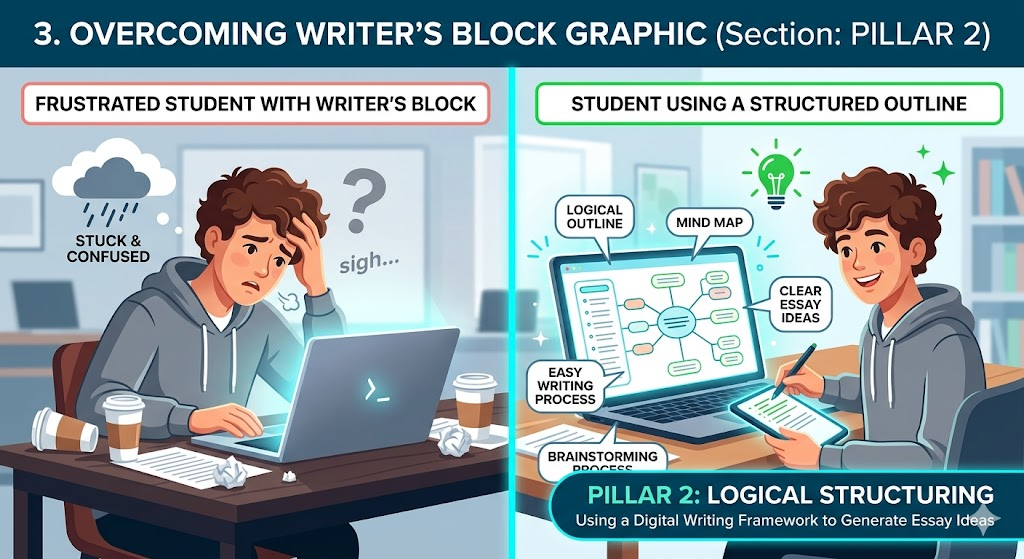
Once you have that “seed” of an idea, the second pillar—logical structuring—takes over. Every paragraph should serve a single purpose. If a sentence doesn’t support the main point of that paragraph, or if that paragraph doesn’t support the overall thesis, it’s just noise. A strong framework ensures that your reader is never lost, leading them from the introduction to the conclusion like a tour guide leading a group through a museum.
Pillar 3: Evidence Integration (The “Show, Don’t Tell” Rule)
In the professional world and in high-level academia, an opinion without evidence is just a rumor. The third pillar of excellence is the ability to weave research into your own narrative. This doesn’t mean “padding” your paper with long quotes. In fact, too many quotes can actually weaken your voice.
The goal is to paraphrase effectively and then explain why that specific piece of evidence matters. Think of your evidence as the witness in a court case; your job as the writer is the lawyer who explains to the jury why that witness’s testimony proves your point. This level of synthesis shows professors that you have actually digested the material, rather than just copying and pasting from a search engine.
Pillar 4: Technical Precision and the Global Tone
As the world becomes more interconnected, students are often writing for a global audience. Whether you are in London, New York, or Sydney, your writing needs to be “clean.” Technical precision involves more than just checking for spelling errors; it involves tone.
A global tone is professional, objective, and inclusive. It avoids slang, regional idioms that might confuse an international reader, and overly emotional language. Mastery of this pillar ensures that your work is taken seriously by scholars across the globe. It’s the “polish” that makes your work look like it belongs in a peer-reviewed journal rather than a social media post.
Pillar 5: The Revision Loop
Many students think that once they hit the word count, the job is done. In reality, the best writers spend as much time revising as they do drafting. Revision is the process of looking at your work with “cold eyes.” It’s about checking if your arguments actually hold water and if your transitions between paragraphs are smooth.
This final pillar is what separates the elite from the average. It requires patience and a bit of humility—being willing to delete a paragraph you spent an hour on because it doesn’t actually fit the final draft.
Why a Framework is Your Best Career Asset
The skills you develop by following these five pillars don’t disappear once you graduate. In the corporate world, the ability to communicate clearly, back up your claims with data, and meet a deadline is incredibly rare. By investing in your writing framework now, you aren’t just getting a degree; you are building a professional reputation.
Academic excellence isn’t a gift you are born with; it’s a habit you cultivate. Whether it’s through self-discipline, peer review, or professional guidance, the tools you use to build your framework today will be the same tools you use to lead projects and influence people in your future career.
Frequently Asked Questions (FAQ)
1. Is it okay to use digital tools for my assignments?
Ans: Yes, as long as they are used as part of a learning process. Tools that help with brainstorming, outlining, or checking your grammar are essential in the modern era. The key is to ensure the final ideas and analysis are your own.
2. How long does it take to develop a writing framework?
Ans: It’s a continuous process. Most students start to see a significant improvement in their grades within one semester of consistently applying a structured approach to their essays.
3. Why do professors care so much about citations?
Ans: Citations aren’t just about avoiding plagiarism; they are about giving credit to the “intellectual ancestors” of your ideas. It shows you have done your research and respect the academic community.
4. What is the most common mistake students make in essay writing?
Ans: The most common mistake is starting too late. Without time, you cannot follow the “revision loop,” which is usually where the most significant grade improvements happen.
5. How can I make my writing sound more professional?
Ans: Focus on “active voice” rather than “passive voice.” Instead of saying “The experiment was performed by the team,” say “The team performed the experiment.” This makes your writing more direct and authoritative.
About The Author
I am Ruby Walker, an academic consultant and educational strategist associated with MyAssignmentHelp. With over a decade of experience in higher education and content development, I specialize in helping undergraduate students navigate the complexities of academic writing and research methodology.