
The global perfume market is a multi-billion dollar industry driven not only by exquisite olfactory compositions but also by visual storytelling. The first point of contact a consumer has with a fragrance is its vessel. A beautifully designed bottle communicates luxury, sophistication, and identity. However, maintaining the physical integrity of that vessel and protecting the precious liquid inside relies on a highly specialized piece of industrial technology: the perfume bottle crimping machine.
Behind every elegant mist of perfume lies a complex, airtight seal engineered to block oxygen, prevent evaporation, and secure the pump mechanism to the glass neck. Without a high-quality crimping process, even the most expensive fragrance would rapidly degrade, leak during transit, or fail to spray correctly. This comprehensive guide explores the technology, mechanisms, types, and operational standards of perfume bottle crimping machinery, demonstrating why it remains an indispensable asset for artisanal perfumers and mass-market manufacturers alike.
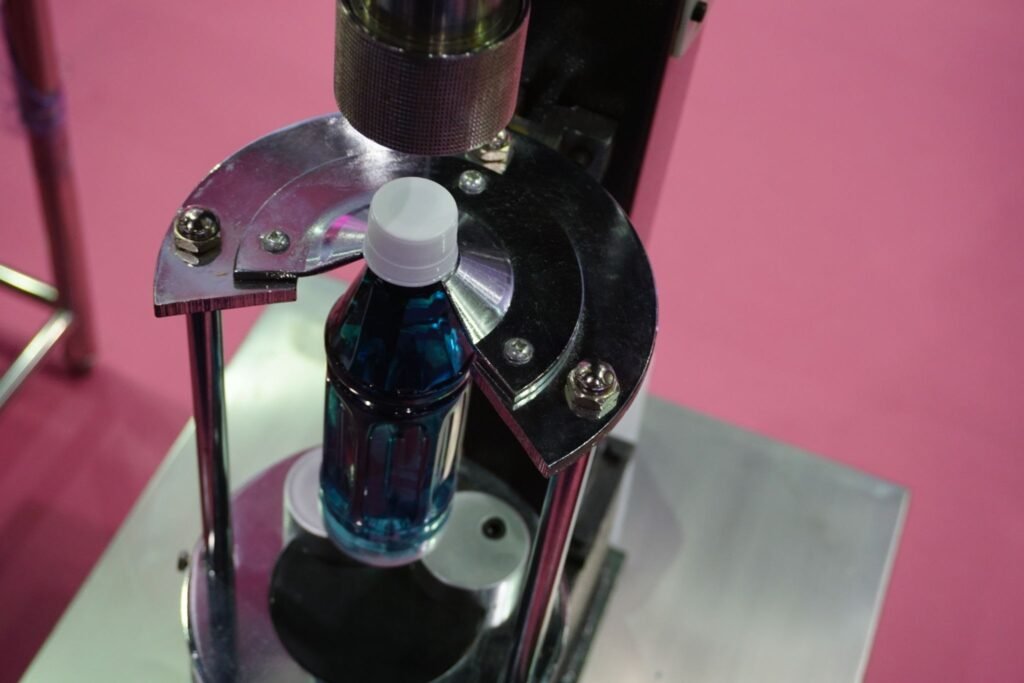
A specialized crimping head securing a pump collar. Source: Supersmario / Getty Images
What is a Perfume Bottle Crimping Machine?
At its core, a perfume bottle crimping machine is a mechanical device designed to attach spray pumps and metal collars securely to the necks of glass perfume bottles. Unlike twist-off caps or simple snap-on mechanisms, high-end perfume bottles require a permanent, airtight, and tamper-evident seal. The crimping process involves using a specialized metal head (often called a crimping collet) that applies uniform radial pressure around a metal cap, deforming it slightly so that it grips the glass lip of the bottle neck.
This mechanical deformation creates a hermetic seal. The primary purpose of this seal is twofold: it prevents the volatile essential oils and alcohol-based solvents in the perfume from evaporating, and it ensures that external air cannot enter the bottle to oxidize and spoil the fragrance. By compressing the internal rubber gasket of the spray pump against the glass rim, the crimping machine guarantees leak-proof performance under varying atmospheric pressures, such as those experienced during air transport.
Key Components of a Crimping Machine
Understanding the anatomy of a perfume bottle crimping machine helps manufacturers select the right equipment for their production lines.
The most critical component is the crimping head or collet. This element is typically made of hardened steel or alloy, featuring segmented fingers that contract inward when mechanical force is applied. These fingers match the specific diameter of the spray pump collar, which usually ranges from 13mm to 20mm.
The pneumatic cylinder or mechanical lever serves as the primary force generator. Pneumatic systems use compressed air to drive the crimping head downward with consistent, adjustable force, whereas manual machines rely on human physical leverage.
The bottle positioning base or locator keeps the glass bottle perfectly centered beneath the crimping head. Proper alignment is crucial; any slight deviation can crush the glass neck or result in an uneven, leaky crimp.
Finally, pressure and height adjusters allow operators to calibrate the machine for different bottle heights, neck shapes, and glass thicknesses, ensuring versatility across various product designs.
The Different Types of Perfume Bottle Crimping Machines
To accommodate different scales of production, manufacturers rely on three primary categories of crimping machinery, each offering unique trade-offs in speed, cost, and labor requirements.
Manual Perfume Crimping Machines
Ideal for small-scale operations, independent perfumers, and laboratory sampling, manual crimping machines are entirely hand-operated. They do not require electricity or compressed air, making them highly portable and affordable. The operator places the bottle on the base, positions the pump, and pulls down a heavy-duty hand lever. While slow—typically producing between 10 to 15 bottles per minute—these machines offer excellent tactile feedback, allowing operators to feel the resistance and ensure a solid finish.
Pneumatic and Semi-Automatic Crimping Machines
For growing mid-sized brands, pneumatic semi-automatic crimping machines offer the perfect balance of efficiency and affordability. Powered by compressed air, these machines initiate the crimping cycle via a foot pedal or a dual-button safety trigger. The operator manually loads the bottle and pump, but the machine handles the physical crimping force. This drastically reduces operator fatigue and increases output to 20 to 40 bottles per minute, ensuring perfect uniformity across every single run.
Fully Automatic Inline Crimping Systems
Designed for industrial, high-volume manufacturing facilities, fully automatic systems are integrated directly into automated packaging lines. Starwheels or conveyor belts transport filled bottles beneath the crimping station. Mechanical arms automatically feed the spray pumps onto the bottles, align them, and lower high-speed rotary crimping heads to seal them instantly. These advanced systems can process hundreds of bottles per hour with minimal human intervention, utilizing built-in sensors to detect and reject any improperly crimped units.
How to Calibrate and Operate a Crimping Machine
Achieving a flawless seal requires careful setup and routine calibration. Operators must begin by selecting a crimping collet that precisely matches the outer diameter of the pump collar. Even a millimeter of difference can cause metal tearing or inadequate sealing.
Next, the height of the crimping head must be adjusted so that it descends to the exact depth required to compress the internal gasket without exerting excessive downward pressure on the glass bottle.
For pneumatic models, the air pressure must be dialed in correctly, usually between 0.4 and 0.6 MPa. If the pressure is too low, the metal collar will not deform enough to lock under the glass neck, resulting in a loose pump that spins when twisted. Conversely, if the pressure is set too high, the brute force will shatter the glass neck, creating hazardous waste and halting production. Running a few test bottles at the start of a production shift is essential to verify the seal quality before launching a full run.
Common Crimping Issues and How to Solve Them
Even with high-quality machinery, operators occasionally run into quality control issues that can compromise the final product.
One of the most frequent problems is collar spinning, which occurs when the pump can be rotated after crimping. This is almost always caused by insufficient radial pressure or an incorrectly sized collet. To fix this, operators should slightly increase the pneumatic air pressure or adjust the stroke depth of the crimping head to ensure a tighter grip.
Another common issue is glass breakage at the neck of the bottle. Glass bottles naturally have slight dimensional variations from batch to batch. If the machine is set to a rigid, unyielding height, a slightly taller bottle will bear too much vertical load and crack. Utilizing a spring-loaded crimping head or slightly reducing the downward stroke depth can absorb these minor variances and prevent cracking.
Finally, wrinkled or deformed collars ruin the luxury aesthetic of the perfume packaging. This visual defect happens when the crimping fingers are worn, misaligned, or dirty. Regular cleaning of the collet to remove metal shavings, along with routine lubrication of the moving joints, will keep the crimping fingers contracting smoothly and leave a pristine, mirror-like finish on the metal collar.
Conclusion
The perfume bottle crimping machine is far more than a simple capping tool; it is the silent guardian of a fragrance’s shelf life, aroma profile, and luxury appeal. By choosing the right machinery—whether a hand-operated manual lever for boutique creations or a high-speed pneumatic system for growing brands—manufacturers can ensure that every bottle leaves the assembly line hermetically sealed and visually flawless. Investing in high-grade crimping equipment, executing precise calibrations, and committing to routine maintenance are vital steps for any fragrance brand dedicated to delivering an uncompromised sensory experience to its customers.